AI Foundations
8 AI Terms Explained With Real Tasks: Agents, MCP, Skills and More
Understand harnesses, agents, MCP, skills, feedback loops, computer use, GEO/AEO and AGI with plain-English examples.
In this guide
The useful starting point
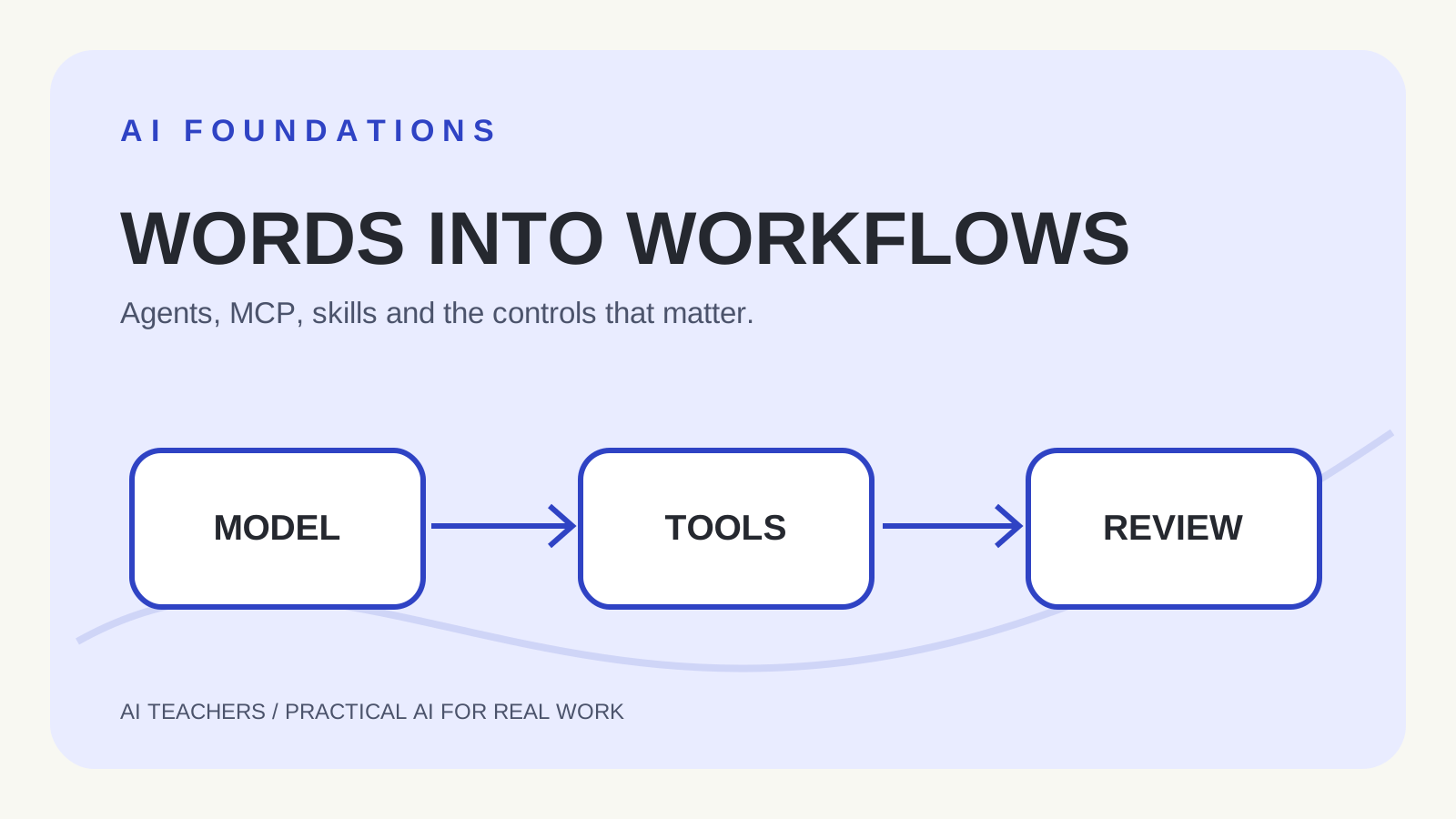
An AI model produces results; a harness supplies surrounding tools and controls; agents may take multiple steps; MCP connects compatible tools; skills capture reusable procedures. Computer use operates interfaces, while GEO/AEO concern discoverability and AGI remains debated.
Prompts are only one part of modern AI. Once assistants can look up information, operate tools, remember procedures and check work, a new vocabulary becomes useful. You do not need to memorize buzzwords; you need to ask what a feature actually lets the system do.
Eight ideas in everyday language
Agent
An AI application that can choose or carry out steps toward a goal using permitted tools. A chatbot answering one question is not automatically an autonomous agent.
Question to ask: Ask what it can do without you and which actions require approval.
Harness
The surrounding software that gives a model inputs, tools, instructions, permission checks and a way to verify or stop work.
Question to ask: Two apps using the same model can behave differently because the surrounding system differs.
MCP (Model Context Protocol)
A standard way for compatible AI applications to discover and use tools or information provided by connected services.
Question to ask: A connection grants a route to a tool; it does not mean every operation is permitted.
Skill
A reusable set of instructions, templates or supporting resources for accomplishing a defined task.
Question to ask: A skill tells an assistant how to prepare a report; a connection supplies the approved report data.
Loop engineering
Designing how a system acts, checks feedback, retries, escalates and decides when to stop.
Question to ask: For a coding example, stop after three failed tests and ask a person to investigate.
Computer use
AI interaction with graphical interfaces through visual inspection, clicking and typing rather than direct APIs.
Question to ask: A visible browser action is still a real action. Review before submitting forms, purchases or messages.
GEO and AEO
Overlapping approaches to making information useful and discoverable in generated answers and direct-answer experiences.
Question to ask: Provide clear, accurate descriptions and track citations; there is no guaranteed AI ranking.
AGI and superintelligence
Debated labels for broad general capability and capabilities beyond human intellectual performance, respectively.
Question to ask: A strong performance in one subject is not proof of either label.
An example: the same simple task, with and without connections
Imagine preparing a weekly summary from a fictional customer-question spreadsheet. A basic model can draft a structure from the rows you paste. A tool connection could retrieve an authorized file. A saved skill could define how to count questions and label unclear entries. An agent could run several steps, check the output and ask you to approve it. The harness determines which permissions and checks are actually available.
That example does not require a real customer file. You can practice with made-up data, inspect every intermediate step and keep sending or publishing disabled.
A ten-minute terminology exercise
- Pick one term above and write your own one-sentence definition.
- Choose one simple task, such as turning mock notes into an action list.
- Label which parts require a model, a data connection, a reusable procedure, and a human review.
- Ask an assistant to identify any missing permissions or stop conditions.
- Explain the task back to a friend without using unexplained acronyms.
I am learning about [term]. Explain it using a simple fictional team task. Contrast it with the nearest related term, give one practical limitation, and ask me a question that checks whether I understand the difference. Do not invent product access or actions.
What matters more than the vocabulary
A credible workflow has defined inputs, a specific output, permissions appropriate to the work and a way to catch mistakes. Continue with our guide to RAG, MCP, agents and embeddings or the foundations learning path. Use the words to ask better questions, not to sound more technical.
Further reading: Jim Clyde Monge's October 2026 AI terminology article; MCP documentation; Anthropic on agents; OpenAI on harness engineering. This is an independent educational explanation.
Questions you might be asking
What is the difference between an AI skill and MCP?
MCP is a standardized connection mechanism for compatible tools and data; a skill is a reusable task procedure. They can complement each other.
Is every AI chatbot an agent?
No. Agent behavior involves deciding or executing steps toward a goal with an appropriate environment and tools; a single response does not establish that.
Does a tool calling itself an agent mean it can act independently?
No. Check specific permissions, review steps and demonstrated behavior before relying on the label.
Sources and further reading
- Original terminology inspiration, Jim Clyde Monge (2026)
- Model Context Protocol
- Anthropic: Building effective agents
- OpenAI: Harness engineering
Sources checked October 16, 2026. Review the linked publisher information for current details.
Put one idea to work
Use one lesson in a small project, explain what you learned, and practice again without relying on the answer.
Try the free workshop →Explore more from AI TeachersKeep practicing
 Team learning
Run a useful AI practice session with your team
A 45-minute session plan that turns one familiar task into a reviewed work sample, with a clear owner and a sensible next experiment.
October 18, 2026 · 3 min read AI Tool Guides
10 AI Tools to Explore: Learn One Useful Skill Before You Subscribe
Meet ten AI tools for note-taking, visualization, email, research and automations, with a safe beginner experiment for each.
October 18, 2026 · 7 min read