Practical AI workflows
Steal my AI workflow stack: turn one real task into a process you can repeat
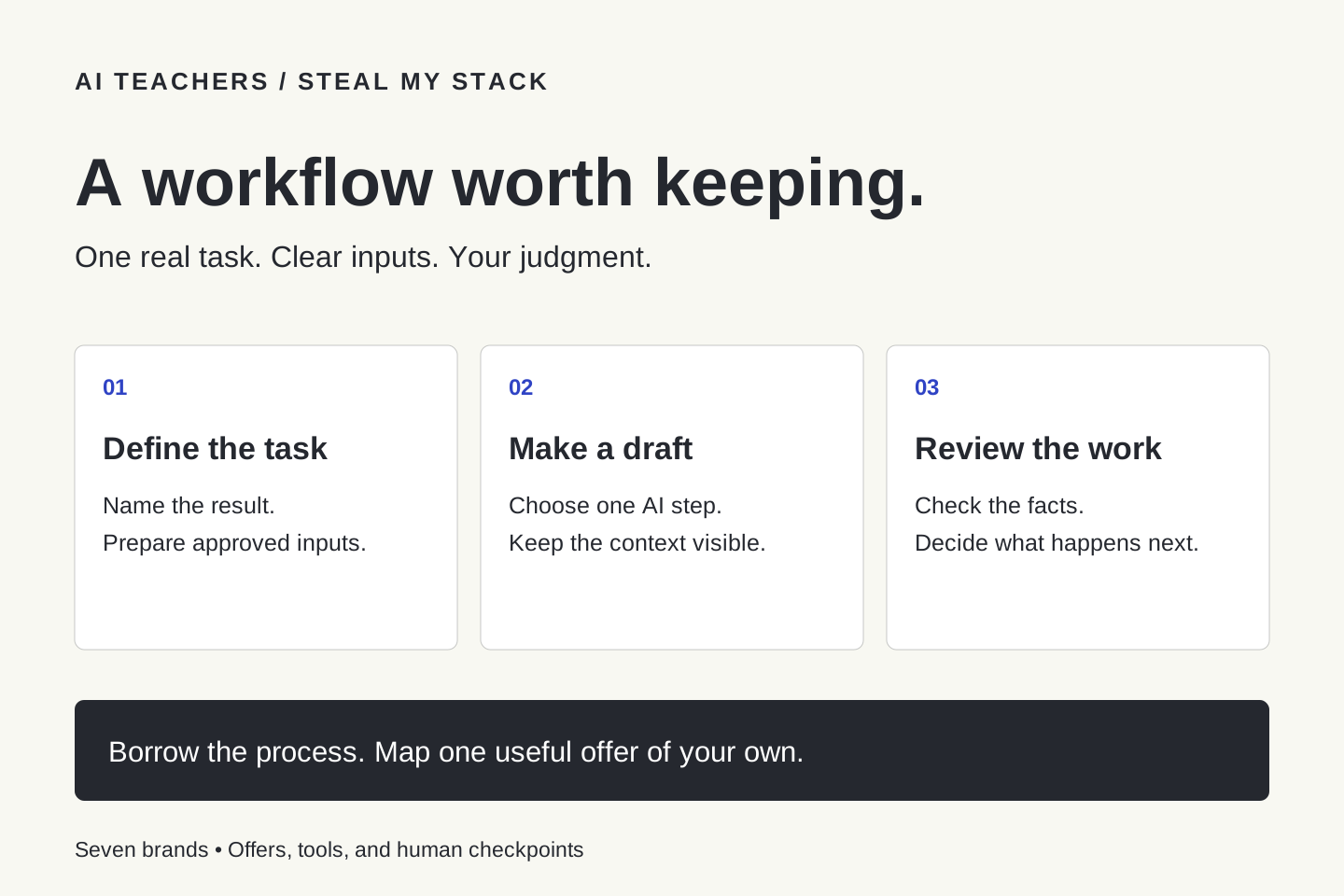
Borrow the AI Teachers part of Ashley Kays's seven-brand map. Define a task, prepare context, choose an AI step, and keep useful human checkpoints.
In this guide
The useful starting point
Choose one task, name the result, prepare approved inputs, and decide what a person must review. Test one AI-assisted step, then record the full effort and quality before repeating it.
By Ashley Kays · Steal My Stack
Choose a task you do often enough that improving it would matter: preparing for a meeting, organizing research, drafting a useful document, or reviewing work before it goes to a client. Now map the inputs, steps, tools, and points where your judgment matters.
That is the learning angle in AI Teachers' part of my seven-brand Steal My Stack map. I built seven online brands and mapped the offers, tools, and workflows behind them so you can borrow a useful process for your own work. Download the complete brand map to see the examples together.
A useful stack starts with the task
Write the result you need before choosing the application. A campaign brief, a research summary, and a client follow-up draft have different inputs and quality standards. Your tools should support those requirements.
The aim is a process you understand well enough to use again, adjust when needed, and explain to someone else. A finished draft is one part of that process. Preparing the material and checking the result are part of the work too.
Map six decisions before you begin
| Decision | What to write down |
|---|---|
| Goal | The finished result and who will use it. |
| Context | The audience, constraints, source material, and examples that matter. |
| AI step | One bounded drafting, organizing, or comparison task. |
| Human checkpoint | The facts and decisions a named person will verify or approve. |
| Handoff | The format, recipient, and approval needed before sharing or acting. |
| Learning | What you will record about quality, effort, corrections, and reuse. |
Use the free Workflow Planner to create a starting brief and checklist. Your plan is a document for your own work, not an agent that executes those steps.
Work through a small example
Illustrative task: turn approved product notes into a campaign brief. The starting notes describe the audience, product, confirmed benefits, constraints, and desired reader action.
Ask the assistant to organize those facts and list missing information. Decide which audience and message to pursue. Then ask for a draft containing the audience, problem, message, supporting evidence, and one call to action.
Your review checks that each claim matches the notes, the message makes sense to the intended reader, and the action goes somewhere useful. Keep unresolved details visible. This is a teaching example, not a report of a customer outcome.
Borrow the brief
Help me complete [task] for [audience]. A useful result contains [requirements]. Use only these approved materials: [materials]. First identify missing information and separate facts from assumptions. Then propose a short workflow with an AI step and human review checkpoints. Wait for my decisions before drafting. Do not publish, send messages, or change connected systems.
Once the plan is clear, choose a small part to try. Keep the original material beside the draft. Verify meaningful facts against that material and make the decisions that require your knowledge of the work.
Learn from a second attempt
Repeat the process with another comparable example. Record time spent preparing, drafting, reviewing, correcting, and handing off. Note which instructions you had to repeat and which errors a checklist caught.
Use those observations to improve the brief. A reusable process should be easier to explain after practice. Keep a short note of when it works well and when you would choose a different approach.
How this connects to an offer
In the seven-brand map, AI Teachers shows how practical knowledge can become a teaching offer. Our current paths include a private AI Working Session for one agreed task and separately scoped team training. The free planner and lessons help people begin on their own.
The map shows available resources and offers; it does not claim that every brand is earning or that a workflow produces a guaranteed result. The useful part to adapt is the connection between a person's problem, an achievable outcome, and a process you can explain.
Choose your starting point
Plan one AI workflow for free. If you want help applying it, explore a 90-minute AI Working Session or discuss a team lab. You can also explore all seven brands in the stack and choose the example closest to your goal.
Questions you might be asking
Do I need all the tools in the seven-brand map?
No. Begin with the tools appropriate for one task and the information you are allowed to use. The wider map shows different examples, not a required shopping list.
Does the Workflow Planner run the task for me?
No. It creates a brief and review checklist for your own work. You choose and use any external tools separately.
Sources and further reading
Sources checked October 23, 2026. Review the linked publisher information for current details.
Put one idea to work
Use one lesson in a small project, explain what you learned, and practice again without relying on the answer.
Try the free workshop →Explore more from AI TeachersGet the free AI at Work Starter Kit →Keep practicing
 Learning With AI
Learn Something Useful With AI Every Day: A Small Routine That Builds Real Skill
Use a short daily AI learning routine with an initial attempt, hints, practice and an independent check so progress means more than reading answers.
October 22, 2026 · 6 min read AI agent workflows
From AI prompts to a workflow you can trust with real work
Learn a practical method for choosing, briefing, testing and improving an AI agent, with a free tutorial, planner and starter kit.
October 22, 2026 · 7 min read