AI workspaces
ChatGPT Work vs. Codex: choose the workspace that fits the job
Understand ChatGPT Work, Codex, and Astra reasoning settings, with examples for research, documents, websites, software projects, and everyday work.
In this guide
The useful starting point
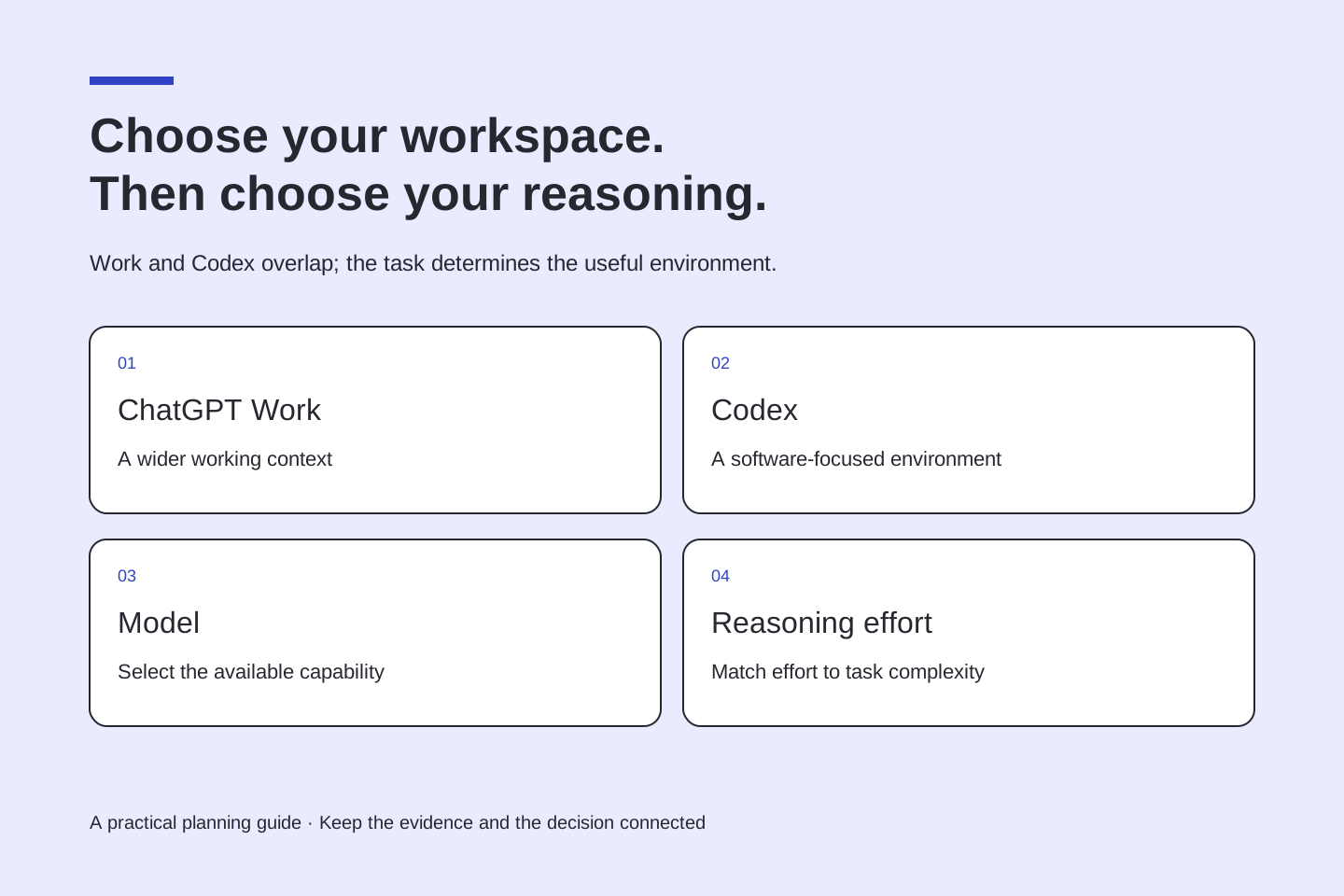
Choose Work for the wider task and Codex for a software-focused workspace. Model choice and reasoning effort are separate settings; both environments can overlap in what they do.
The question “Should I use ChatGPT Work or Codex?” becomes easier when you name the result you want. A client-ready report, a redesigned onboarding flow, and a bug fix may all need strong reasoning. They need different kinds of visibility while the work happens.
ChatGPT Work and Codex overlap in what they can do. The practical difference is how you work with the agent, which environment it can access, and how much technical detail you want to inspect.
Separate the workspace from the model
Work and Codex are experiences for doing work. Astra is a model. Extra High is a reasoning setting. GitHub, Railway, and Supabase are services that may be connected to a workflow.
These choices are related, but they do not substitute for one another. Selecting Astra does not connect a repository. Choosing Extra High does not authorize a deployment. Opening Codex does not automatically move your local files into a cloud environment.
When Work is a good starting point
Choose Work when you can describe a finished outcome and want the agent to coordinate research, files, or connected tools around it. For example: compare three vendor proposals, build a decision table, and produce a recommendation grounded in the source documents.
For a small business website, you might ask Work to develop the offer, write the page, create the site, and verify the enquiry path, using the tools actually available. The success criteria should describe the customer experience and the deliverable you expect to inspect.
Try this:
Use these source documents to create a customer onboarding improvement plan. Identify the three most consequential points of confusion, cite the evidence, propose changes, and produce a one-page brief with owners and acceptance criteria. Label assumptions and missing data.
That is a work assignment with a reviewable result. It gives the agent a clearer destination than “help me improve onboarding.”
When Codex is the better working view
Choose Codex when the repository and implementation are central to the task. You may want to inspect changed files, understand a failed command, review a pull request, or check how a feature was tested.
For example:
Inspect the onboarding code in this repository. Find why a completed step appears incomplete after refresh. Reproduce the issue, make the smallest maintainable fix, run the relevant checks, and show the changed files and any remaining risk.
You can still ask for plain explanations. Technical visibility does not require that every response be a wall of commands.
OpenAI's current comparison also makes clear that Codex can handle research and documents. The distinction is not an absolute wall between “business work” and “coding.” Choose the view that helps you direct and evaluate the task.
Choose where the work runs
Local work uses the project and tools available on your computer. A worktree can isolate a set of code changes. Cloud tasks use their configured environment and accessible services. A browser sign-in or local server on your laptop is not automatically present in a cloud task.
If an agent cannot reach a system, ask it to identify the missing access and the supported next step. Do not solve every access problem by handing over broader credentials.
How Astra Extra High fits
For a difficult brief involving architecture, conflicting evidence, or several interdependent decisions, Astra Extra High is an option to consider where available. For a simple title change or a well-defined formatting task, a lighter setting may be enough.
Use an actual task to assess the tradeoff. Keep the input and evaluation criteria stable, then compare the amount of correction needed, completion time, and usage. Do not assume that a longer answer or a higher setting means a better outcome.
Four practical choices
| Your immediate need | A useful starting point | Evidence to review |
|---|---|---|
| Research and a client-ready recommendation | Work | Source links, assumptions, final document |
| A small app from a clear brief | Work or Codex | User journey, repository, deployed behavior |
| A bug fix in an existing application | Codex | Reproduction, diff, relevant checks |
| An ongoing workflow across business tools | Work, with appropriate connections | Actual records touched and a verified result |
These are workflow recommendations, not claims that one product uniquely owns each capability.
Ask for evidence at the end
The same finishing question improves either experience:
What did you complete, what did you directly verify, what remains uncertain, and where can I inspect the result?
For code, the answer may include a commit, test output, and deployment. For research, it may include primary sources and unresolved contradictions. For an email campaign, it may mean a prepared draft rather than a sent message.
The most productive choice is the environment that lets you give good context and judge the finished work. Start there, then adjust the model and reasoning effort to the difficulty of the task.
Sources and further reading
- OpenAI: Use ChatGPT; Work and Codex comparison
- OpenAI: Get started with ChatGPT Work
- OpenAI: Codex environments
- OpenAI: Codex CLI
- OpenAI: Models and reasoning settings
- OpenAI: Model selection
Sources checked October 19, 2026. Review the linked publisher information for current details.
Put one idea to work
Use one lesson in a small project, explain what you learned, and practice again without relying on the answer.
Try the free workshop →Explore more from AI TeachersGet the free AI at Work Starter Kit →Keep practicing
 AI Foundations
RAG, MCP, Agents and Embeddings: The AI Terms That Help You Make Better Choices
Learn essential AI vocabulary through a practical document-assistant example, with clear distinctions between retrieval, connections, actions and evaluation.
October 19, 2026 · 5 min read AI building
From idea to a working app: ChatGPT Work, Astra, GitHub, Railway, and Supabase
A practical workflow for building a small app with ChatGPT Work or Codex, creating a GitHub repo, deploying on Railway, and saving data with Supabase.
October 19, 2026 · 7 min read