AI & changing work
Want to teach AI? Help someone finish a real task
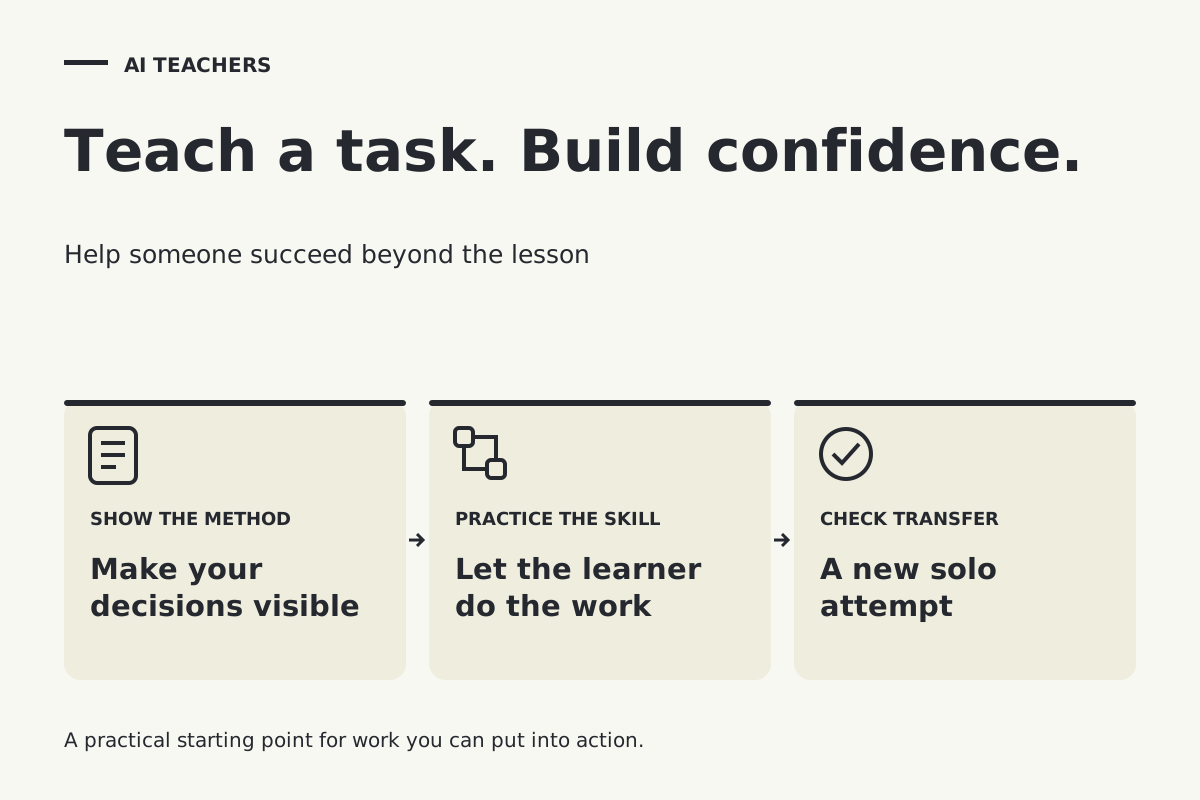
A useful AI lesson ends with a learner who can do something independently. Start with one task, build a short practice session, and check what carries over into their next attempt.
In this guide
The useful starting point
Define one task and the result a learner should produce without your help.
Build your first lesson around an observable result
Indeed’s 2024 article prompted this practical look at changing work.
Pick a task you understand well enough to explain and evaluate: turning meeting notes into next steps, organizing research into a comparison, or preparing a customer-response draft. Define the result in a sentence. 'Create an accurate action list from these notes and identify anything that needs clarification' gives you a much stronger teaching goal than 'understand AI.'
You do not need to teach every feature in a product. You do need to know the task, the mistakes a learner may encounter, and how to help them judge the output. Begin with the tools and access they already have. A session should not depend on an account upgrade the learner discovers halfway through the exercise.
Design a lesson someone can use tomorrow
Use a short demonstration, guided practice, an independent attempt, and a reusable job aid. In the demonstration, explain your decisions aloud: why you included a source, why a missing detail should stay missing, and how you checked the result. Make the reasoning visible alongside the prompt.
During guided practice, let the learner do the work. Ask what they expect before running the task and what they would inspect afterward. When something goes wrong, help them find the cause. They might need a clearer input, a narrower request, or a better way to compare the answer with the source.
The CDC's training standards include learner assessment and follow-up support. Those are useful design principles for this kind of teaching: assess the skill directly, then give the learner a simple resource for the next attempt. A satisfied reaction at the end of a session does not show whether the person can complete the task independently.
Your four-step starting plan
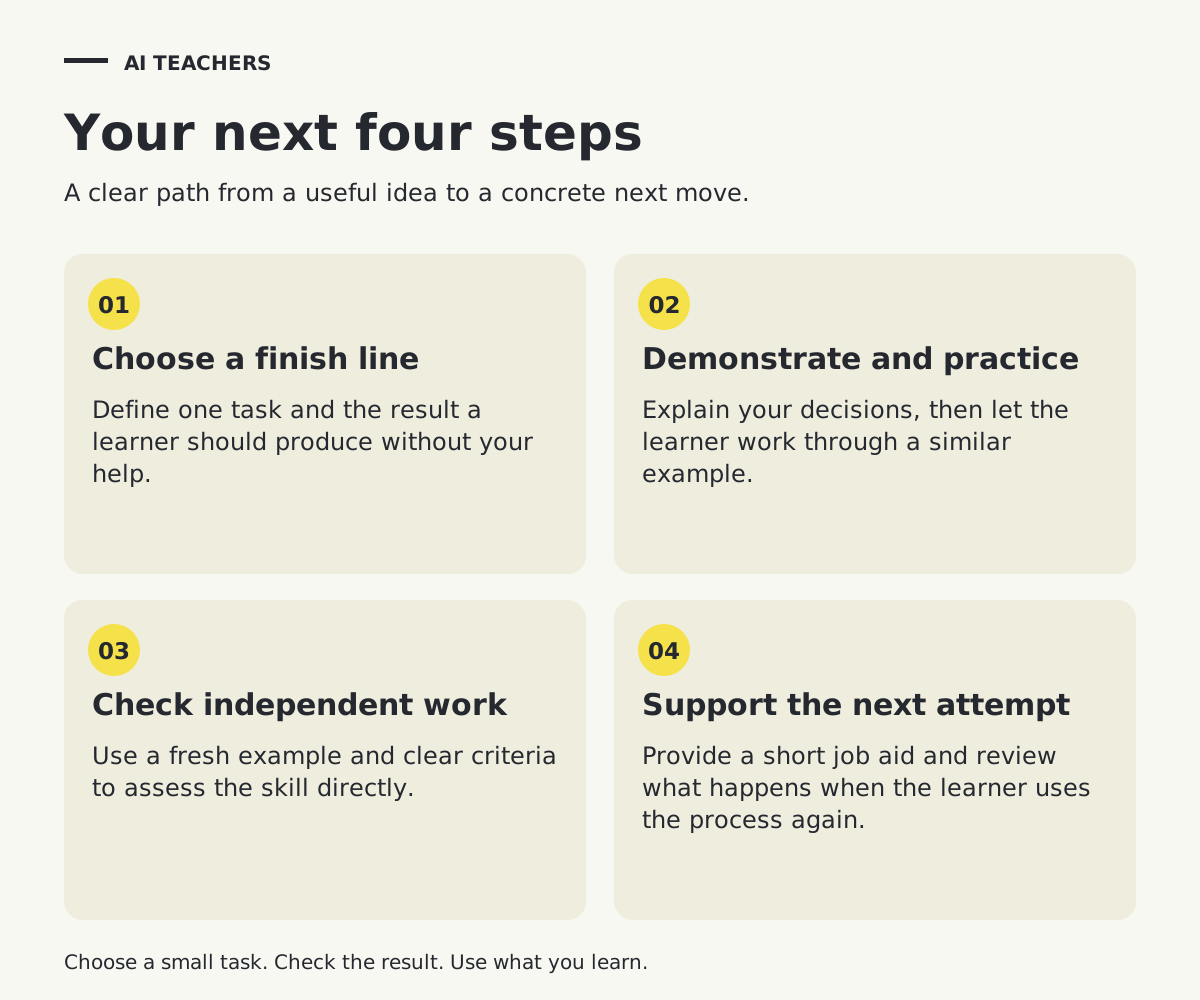
- Choose a finish line
Define one task and the result a learner should produce without your help.
- Demonstrate and practice
Explain your decisions, then let the learner work through a similar example.
- Check independent work
Use a fresh example and clear criteria to assess the skill directly.
- Support the next attempt
Provide a short job aid and review what happens when the learner uses the process again.
A lesson you can build: meeting notes to a reliable action list
Prepare two short sets of sample meeting notes. In the first, include explicit decisions, named owners, and a few deadlines. Add one suggestion that nobody agreed to pursue. Demonstrate how to request a table of actions and supporting phrases without treating every idea as a commitment.
Ask the learner to check each row against the notes. They should remove actions that were never agreed, correct mismatched owners, and mark missing dates for clarification. The finished table is useful only when it represents the meeting accurately.
Then provide a second set of notes with different wording. This time, let the learner choose the prompt and review method. Ask them to explain one correction and one unresolved question. You now have evidence about the skill they practiced, rather than how well they copied your demonstration.
Make progress easy to see
Keep the assessment small. For the action-list lesson, check whether the learner captured the explicit commitments, preserved the stated owners and dates, and flagged gaps. Use the same criteria before and after practice. If you measure time, include checking and corrections so a quick but inaccurate draft does not look like success.
Send learners away with a one-page checklist and a practice task similar to their real work. Agree on a follow-up point where they can show a completed example or describe what stopped them. That conversation helps you improve the lesson and identify whether additional support would be useful.
Your first teaching portfolio can include the objective, sample inputs, lesson sequence, job aid, assessment criteria, and revisions from a pilot session. Report only observations you collected. A focused lesson with clear evidence of learning is a strong foundation for discussing team training work.
Our recommendation: teach one task to a small group before designing a large course. If you would like to experience this approach first, bring a real task to an AI Working Session. Use the process yourself, then adapt the lesson structure to a task you can teach with confidence.
Sources and further reading
- Indeed: Future-Proofing Your Workforce (updated October 31, 2024)
- CDC: Quality Training Standards
- CDC: Evaluate Training—Measuring Effectiveness
Sources checked November 11, 2026. Review the linked publisher information for current details.
Put one idea to work
Use an AI Working Session to work through your own task, check the result, and leave with a practical next step.
Explore AI Working Sessions →Explore more from AI TeachersGet the free AI at Work Starter Kit →Keep practicing
 Agent-friendly websites
Agent-Friendly Website Lesson: llms.txt and Task Testing
A hands-on lesson plan for llms.txt, accessible pages and public APIs, including a fictional site, a six-step exercise and an assessment rubric.
November 11, 2026 · 8 min read AI browser workflows
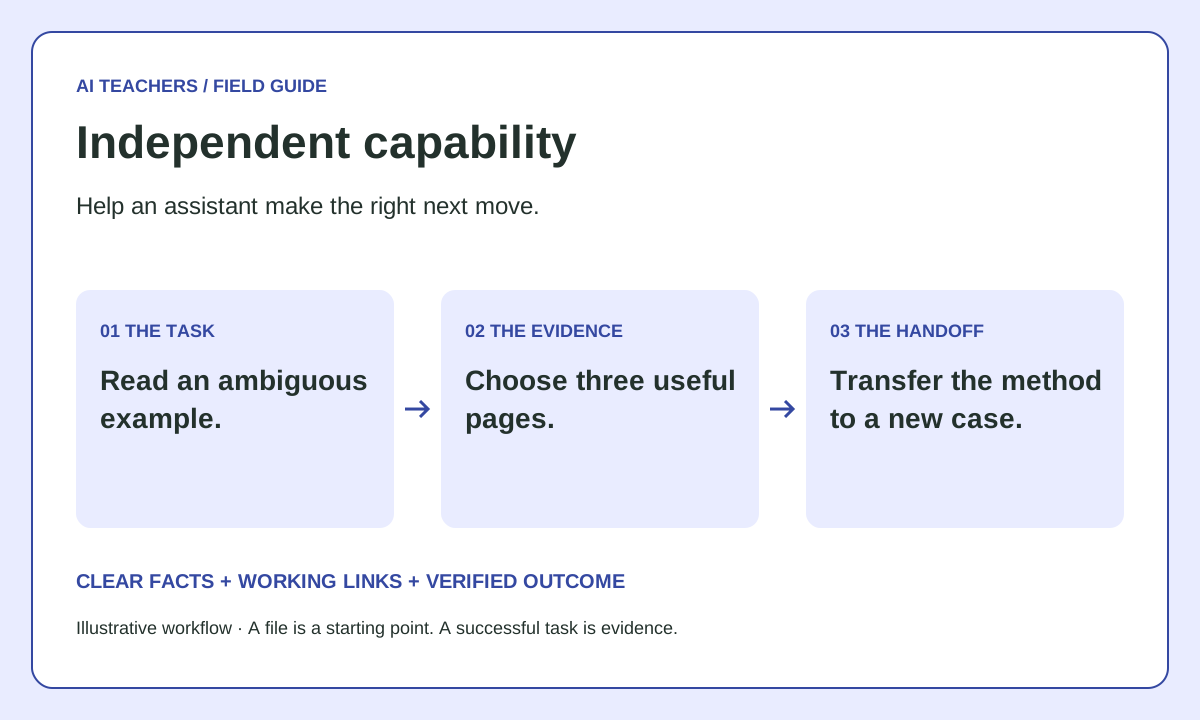
Teach a useful AI skill: read three tabs, check the answer, explain the choice
A practical browser-based AI lesson with five illustrated steps, ready-to-use prompts, a fictional pricing exercise, and a simple assessment of independent source checking.
November 11, 2026 · 8 min read