Practical AI workflows
How to Choose the Right AI Setup for Your Task
Choose the right AI setup for a business task. Compare prompts, reusable skills, fixed workflows and agents, then test your choice with a practical task card.
In this guide
Which AI setup fits the task?
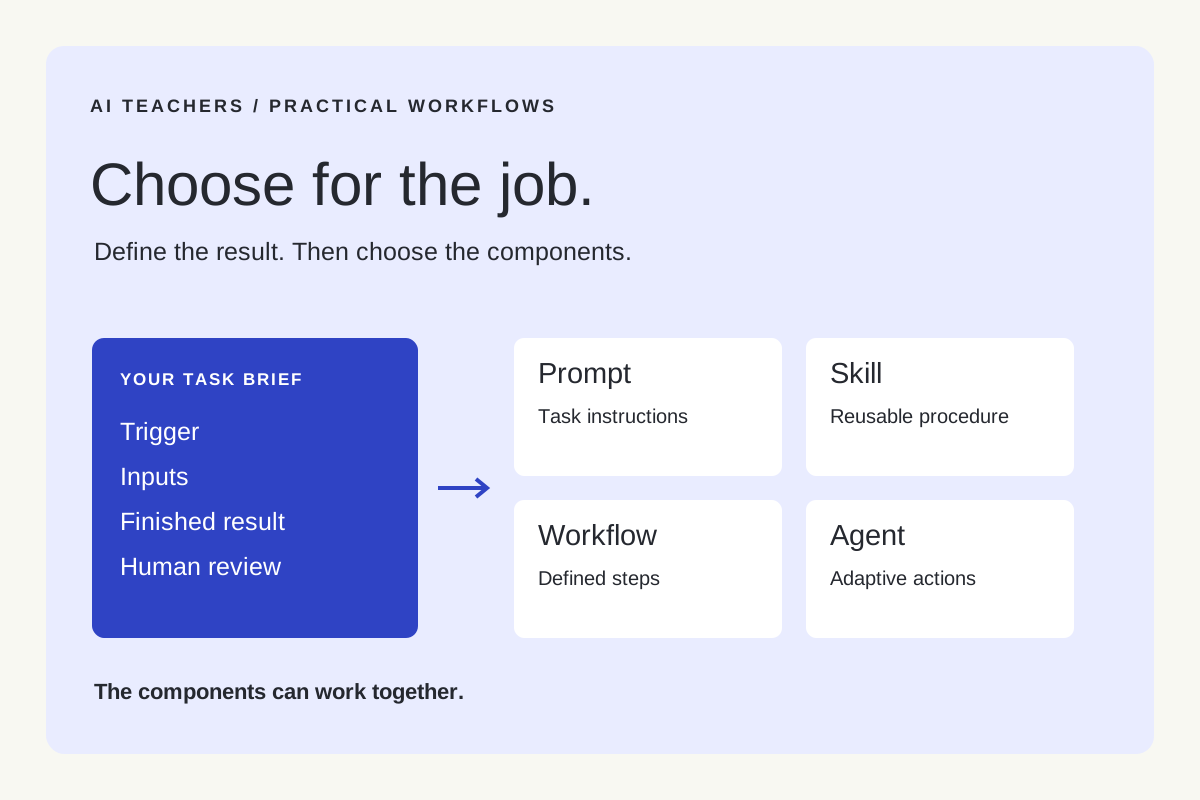
Describe the trigger, inputs, finished result and review point. Use a prompt for instructions, a reusable skill for a tested procedure, a fixed workflow for explicit steps and branches, and an agent when the next action depends on what it discovers. These components can work together.
Before choosing an AI setup, finish this sentence: “When this happens, I need this result.”
That sentence exposes the decisions hiding inside an ordinary task. Consider a fictional repair business receiving customer inquiries. Drafting a friendly reply, checking a booking calendar and deciding which follow-up question to ask are different responsibilities. They may belong in the same process, but each needs a clear owner.
Start by describing those responsibilities. Then choose the components.
Four pieces that can work together
Terminology varies between products. Anthropic’s guide to building effective agents makes a useful distinction: workflows follow predefined paths, while agents let the model decide how to proceed and which tools to use.
Here is a practical comparison for the repair business. Every example below is illustrative.
| Component | What it contributes | Example | What controls the next step? |
|---|---|---|---|
| Prompt | Instructions for a particular task | Draft a reply using the inquiry and service policy | The surrounding conversation or application |
| Reusable skill | A packaged procedure and supporting knowledge | Follow the business’s inquiry triage guide | The system using the skill |
| Fixed workflow | A defined sequence and explicit branches | Receive inquiry, check required fields, prepare draft, request review | Rules written in advance |
| Agent | Decisions about actions as work unfolds | Investigate an unusual request using approved sources and tools | The model, within configured limits |
A prompt can appear inside every other row. An agent can use a skill within a larger workflow. A fixed workflow can call a model; its orchestration may be deterministic even when the model’s wording varies.
Anthropic describes Agent Skills as packages of instructions, scripts and resources that agents can load when relevant. The Agent Skills specification describes a folder containing a SKILL.md file, with optional supporting files. That is one concrete implementation of reusable skills.
A skill file does not, by itself, create a daily schedule or grant access to a mailbox. The host application must provide and enforce those capabilities. Check the product’s actual behavior before treating a familiar label as a promise.
Choose by examining the work
For this repair business, a single prompt may be sufficient when an employee has already collected the relevant facts and wants a reply to review. The person supplies context and decides what happens next.
A reusable skill becomes useful when staff repeatedly apply the same procedure: identify the service category, check for missing information and follow the business’s writing guidelines. Package a procedure after the team has clarified it. Otherwise, reuse can spread an ambiguous instruction.
A fixed workflow fits a process whose branches can be written down. If the inquiry lacks a location, request it. If a required field is complete, continue. If the request is outside the service area, route it to a person. These rules deserve to be visible and testable.
An agent becomes a candidate when the useful next action depends on what it discovers. It might need to consult several approved references, identify a conflict and decide which question would resolve it. That flexibility needs boundaries: permitted tools, a stopping point and a named person for exceptions.
Ask one further question: could a short checklist and an ordinary software rule handle this decision? Write down the answer. It gives the team a reason for adding model judgment wherever it actually helps.
Try this task card
Choose one task that occurs regularly. Complete the following card with a colleague who currently does the work.
- Trigger: What starts the task?
- Inputs: Which facts and documents must be available?
- Finished result: What should exist when the task is complete?
- Fixed rules: Which decisions can be expressed as clear conditions?
- Judgment: What requires interpreting incomplete or conflicting information?
- Tools and access: What may the system read or change?
- Review: Who checks a draft or approves an external action?
- Stop conditions: When should it pause and ask a person?
- Success measure: What evidence would make the result acceptable?
Then mark each step: instruction, reusable procedure, fixed rule or judgment. Several labels may apply. Use that map to sketch the smallest setup you can evaluate.
For this business, an acceptable result might be a draft that uses only verified service information, identifies missing details and makes no unapproved booking commitment. That is more testable than “handle inquiries well.”
Test the choice before expanding it
Collect ten representative, appropriately anonymized examples. Include a routine request, missing information, conflicting instructions and a case that should go to a person.
Run them through the proposed setup. Record what was correct, what needed correction, where the process stopped and whether any action exceeded its intended scope. Compare the effort with the current process, including review time. If an agent is involved, inspect its actions as well as its final answer.
Use the failures to adjust the design. A missing policy might call for a better skill. A predictable routing mistake might call for an explicit rule. A polished but unsupported answer might require better inputs and stricter review criteria.
Keep the task card with the implementation so the next person can understand why each component exists.
For a guided next step, work through the AI Teachers Agent to Outcome tutorial with your completed task card.
Sources and further reading
- Building effective agents
- Equipping agents for the real world with Agent Skills
- Agent Skills specification
Sources checked November 8, 2026. Review the linked publisher information for current details.
Put one idea to work
Use one lesson in a small project, explain what you learned, and practice again without relying on the answer.
Try the free workshop →Explore more from AI TeachersGet the free AI at Work Starter Kit →Keep practicing
 Agent-friendly websites
Agent-Friendly Website Lesson: llms.txt and Task Testing
A hands-on lesson plan for llms.txt, accessible pages and public APIs, including a fictional site, a six-step exercise and an assessment rubric.
November 11, 2026 · 8 min read AI browser workflows
Teach a useful AI skill: read three tabs, check the answer, explain the choice
A practical browser-based AI lesson with five illustrated steps, ready-to-use prompts, a fictional pricing exercise, and a simple assessment of independent source checking.
November 11, 2026 · 8 min read