Practical AI workflows
Teach Claude Sheets and Whiteboards through one useful exercise
A hands-on lesson that ends with a checked budget, a shared plan and an independent learner attempt.

In this guide
How can these tools help with a practical task?
Can the learner build and check a simple workshop materials budget?
A useful AI lesson should leave someone able to do a task after the demonstration ends. Sheets and Whiteboards offer a concrete exercise: turn a short set of planning notes into a budget, check the numbers and explain a decision. Start with synthetic data so learners can focus on the skill.
What Anthropic announced
On November 10, 2026, Anthropic introduced Claude Sheets and Whiteboards in beta and made Claude Data, formerly Dashboards, generally available on paid plans. Sheets supports editable formulas and Excel/CSV export; Whiteboards supports shared visual planning. Data works with connected data sources and adds visual stories, including narrated videos. Certified queries and live sharing remain beta features.
Interactive connectors are also expanding to full app views where supported, including Adobe and Atlassian. Availability depends on rollout and organizational settings. Claude Meetings is described as coming soon in the overview; the Whiteboards help page documents Google Meet beta support on Team and Enterprise. Check your account before planning around it; Zoom and Microsoft Teams are not supported in that documented beta.
Before you start
Open Claude and confirm that your paid account has the Sheets and Whiteboards templates in Artifacts. Team plans enable them by default; an Enterprise owner must enable them. If a template is missing, check your plan and organization settings before following this exercise. No live meeting or connected business account is required for the sample below.
Start a chat, paste the labeled sample data and ask for a Sheet. In a separate request, ask for a Whiteboard using the reviewed findings. Copy the relevant context explicitly: the Whiteboards help page says connected-app context is not currently available to the board. These are suggested prompts, not a transcript of a hands-on test in Claude.
Your four-step workflow
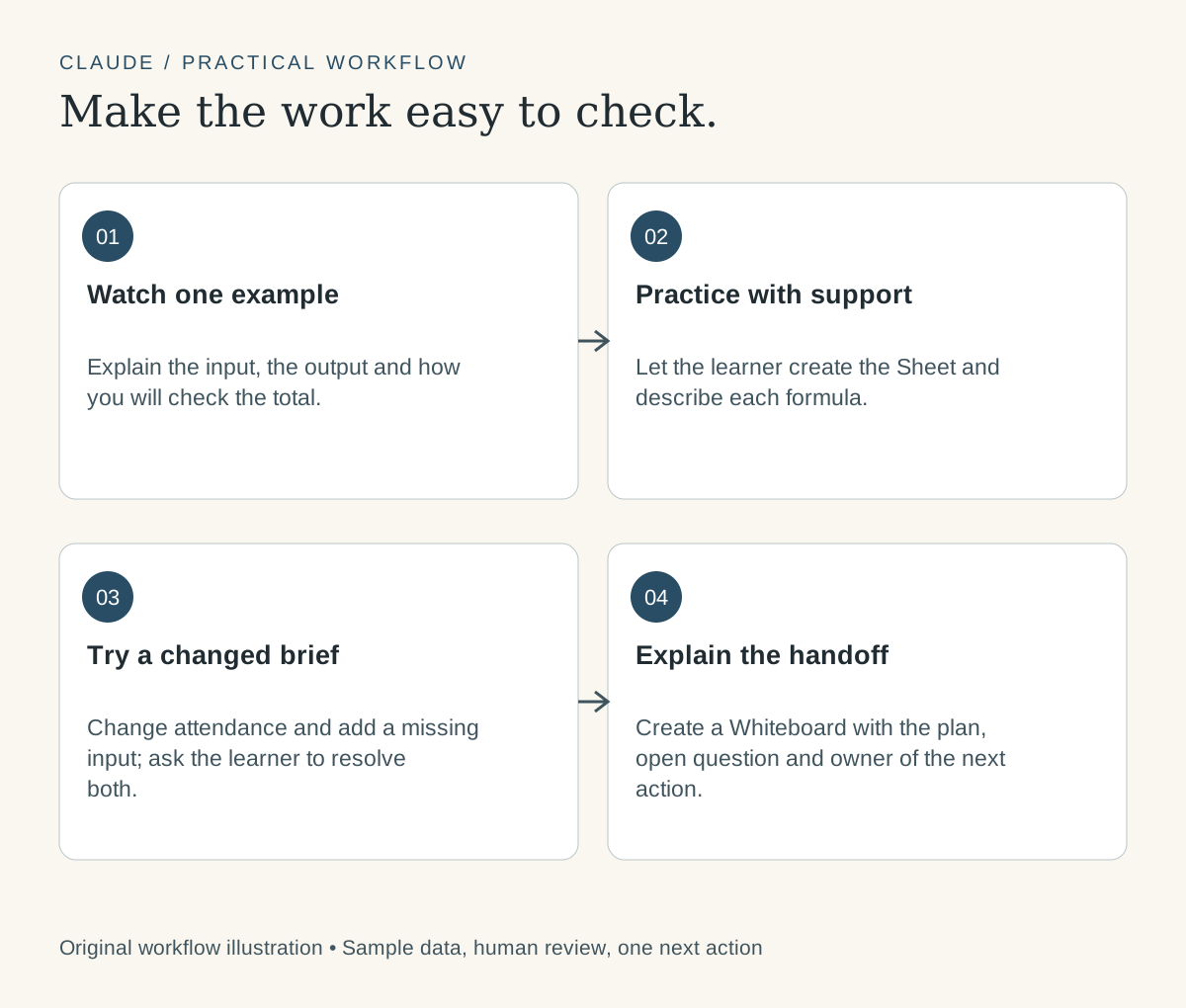
- Watch one example. Explain the input, the output and how you will check the total.
- Practice with support. Let the learner create the Sheet and describe each formula.
- Try a changed brief. Change attendance and add a missing input; ask the learner to resolve both.
- Explain the handoff. Create a Whiteboard with the plan, open question and owner of the next action.
Worked example: Can the learner build and check a simple workshop materials budget?
Fictional practice example. These inputs and expected outputs demonstrate the method. They are not client results, portfolio metrics or evidence that this task was run in Claude.
| Item | Quantity | Unit cost USD |
|---|---|---|
| Notebooks | 8 | 3 |
| Pens | 8 | 1.5 |
| Printed cards | 8 | 2 |
Paste this prompt into Claude
Create a Claude Sheet using only the following SYNTHETIC PRACTICE DATA. Do not connect accounts or invent missing values. Keep raw inputs separate from calculations. Include visible formulas and an Assumptions tab. The decision is: Can the learner build and check a simple workshop materials budget?

Item,Quantity,Unit cost USD
Notebooks,8,3
Pens,8,1.5
Printed cards,8,2

Use these formulas, with the header in row 1:
D2 = B2*C2  → line cost; fill down through D4
D5 = SUM(D2:D4)
D6 = D5/8  → material cost per learner

Explain the calculation and flag missing inputs. Keep zero denominators blank and identify why the result is unavailable. Do not claim these are real business results.
Check the expected result
The sample materials total is $52: $24 + $12 + $16. The cost per learner is $6.50 for eight learners.
The correct total alone is not enough to demonstrate learning. Ask the learner to change attendance to ten, explain what should change and check the new total of $65. Then introduce a missing unit price: the learner should ask for it or mark it unknown, not silently assume zero.
Turn the reviewed result into a board
Create a Whiteboard for this reviewed sample. Make four sections: Evidence, Assumptions, Open questions, and Next action. Evidence: The sample materials total is $52: $24 + $12 + $16. The cost per learner is $6.50 for eight learners. Interpretation to review: The correct total alone is not enough to demonstrate learning. Ask the learner to change attendance to ten, explain what should change and check the new total of $65. Then introduce a missing unit price: the learner should ask for it or mark it unknown, not silently assume zero. Add one owner and review-date placeholder; do not invent names or commitments. Keep the sample labeled fictional. Do not send messages or change connected apps.
Make the handoff useful
Ask learners to describe why a formula is correct, how they know a source is usable and what would make them reject an output. A short follow-up task a few days later can show whether the skill carries over. This is a proposed teaching exercise, not a claim that a class was held or learners achieved a measured result.
Before sharing, check one ordinary row, one missing value and one zero-denominator case. Confirm that totals use the intended rows. Open the exported Excel file and inspect formulas and formatting; a CSV export does not preserve a workbook’s tabs and presentation. Share only the reviewed version with the intended people.
If you later use Claude Data, inspect the data source, metric definition and refresh time. Ask for the uncertainty to appear in any data story. If Meetings is available to your team, follow your organization’s participant-notice and recording practices; otherwise use notes you are permitted to share. The worksheet exercise works without a meeting assistant.
Try it on one real task
Replace the sample with data you are authorized to use, keep the same review question and record what needed correction. A useful first result is a checked artifact and a decision someone can act on.
Official sources
Feature information checked November 11, 2026. Examples, prompts and interpretation are original editorial guidance.
Sources and further reading
- Anthropic: Sheets, Whiteboards and Data — November 10, 2026
- Claude Help: getting started with Sheets
- Claude Help: Whiteboards, including Meetings availability and limitations
- Anthropic: interactive connectors and full apps
- Anthropic: the wider workplace announcement
Sources checked November 11, 2026. Review the linked publisher information for current details.
Put one idea to work
Ask learners to describe why a formula is correct, how they know a source is usable and what would make them reject an output. A short follow-up task a few days later can show whether the skill carries over. This is a proposed teaching exercise, not a claim that a class was held or learners achieved a measured result.
Try the free AI practice workshop →Explore more from AI TeachersGet the free AI at Work Starter Kit →Keep practicing
 Agent-friendly websites
Agent-Friendly Website Lesson: llms.txt and Task Testing
A hands-on lesson plan for llms.txt, accessible pages and public APIs, including a fictional site, a six-step exercise and an assessment rubric.
November 11, 2026 · 8 min read AI browser workflows
Teach a useful AI skill: read three tabs, check the answer, explain the choice
A practical browser-based AI lesson with five illustrated steps, ready-to-use prompts, a fictional pricing exercise, and a simple assessment of independent source checking.
November 11, 2026 · 8 min read